
Friday, October 28, 2011
Thursday, October 27, 2011


Post-4030...
October 18, 2011
A Letter from Goldman Sachs
Concerning Occupy Wall Street
NEW YORK – The following is a letter released today by Lloyd Blankfein, the chairman of banking giant Goldman Sachs:
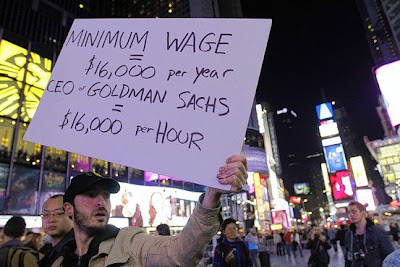 Dear Investor:
Up until now, Goldman Sachs has been silent on the subject of the protest movement known as Occupy Wall Street. That does not mean, however, that it has not been very much on our minds. As thousands have gathered in Lower Manhattan, passionately expressing their deep discontent with the status quo, we have taken note of these protests. And we have asked ourselves this question:
How can we make money off them?
The answer is the newly launched Goldman Sachs Global Rage Fund, whose investment objective is to monetize the Occupy Wall Street protests as they spread around the world. At Goldman, we recognize that the capitalist system as we know it is circling the drain – but there’s plenty of money to be made on the way down.
The Rage Fund will seek out opportunities to invest in products that are poised to benefit from the spreading protests, from police batons and barricades to stun guns and forehead bandages. Furthermore, as clashes between police and protesters turn ever more violent, we are making significant bets on companies that manufacture replacements for broken windows and overturned cars, as well as the raw materials necessary for the construction and incineration of effigies.
It would be tempting, at a time like this, to say “Let them eat cake.” But at Goldman, we are actively seeking to corner the market in cake futures. We project that through our aggressive market manipulation, the price of a piece of cake will quadruple by the end of 2011.
Please contact your Goldman representative for a full prospectus. As the world descends into a Darwinian free-for-all, the Goldman Sachs Rage Fund is a great way to tell the protesters, “Occupy this.” We haven’t felt so good about something we sold since our souls.
Sincerely,
Lloyd Blankfein
Chairman, Goldman Sachs
A Letter from Goldman Sachs
Concerning Occupy Wall Street
NEW YORK – The following is a letter released today by Lloyd Blankfein, the chairman of banking giant Goldman Sachs:
 Dear Investor:
Up until now, Goldman Sachs has been silent on the subject of the protest movement known as Occupy Wall Street. That does not mean, however, that it has not been very much on our minds. As thousands have gathered in Lower Manhattan, passionately expressing their deep discontent with the status quo, we have taken note of these protests. And we have asked ourselves this question:
How can we make money off them?
The answer is the newly launched Goldman Sachs Global Rage Fund, whose investment objective is to monetize the Occupy Wall Street protests as they spread around the world. At Goldman, we recognize that the capitalist system as we know it is circling the drain – but there’s plenty of money to be made on the way down.
The Rage Fund will seek out opportunities to invest in products that are poised to benefit from the spreading protests, from police batons and barricades to stun guns and forehead bandages. Furthermore, as clashes between police and protesters turn ever more violent, we are making significant bets on companies that manufacture replacements for broken windows and overturned cars, as well as the raw materials necessary for the construction and incineration of effigies.
It would be tempting, at a time like this, to say “Let them eat cake.” But at Goldman, we are actively seeking to corner the market in cake futures. We project that through our aggressive market manipulation, the price of a piece of cake will quadruple by the end of 2011.
Please contact your Goldman representative for a full prospectus. As the world descends into a Darwinian free-for-all, the Goldman Sachs Rage Fund is a great way to tell the protesters, “Occupy this.” We haven’t felt so good about something we sold since our souls.
Sincerely,
Lloyd Blankfein
Chairman, Goldman Sachs
Wednesday, October 26, 2011




Post-4026...
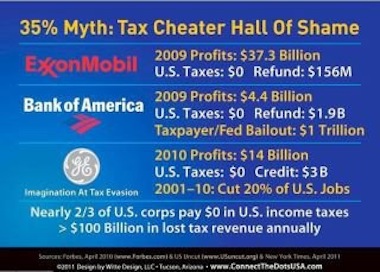 America sacrificed equity for the false promise of efficiency and growth, and society is now more unequal than at any time since the early part of the last century.
Many economists worry that making societies more equal through income redistribution or other means reduces economic growth.
For example, the Bush tax cuts were justified, in part, by the assertion that equity had overshadowed efficiency in tax policy. Taxes on the wealthy, and the inefficiencies that come with them, were much too high, it was argued, and lowering taxes would cause output to go up enough to lift all boats substantially.
Accordingly, the lower end of the income distribution would fare much better after income trickled down than it would under redistributive policy.
 The economy did grow after the Bush tax cuts, but the rate of growth was unremarkable, especially for jobs, and there's little evidence that they caused large increases in output growth, as promised.
In fact, there's little evidence that the Bush tax cuts had any effect at all. The trade-off simply wasn't there.
And the tax cuts at the upper end of the income distribution did nothing to correct for the fact that although worker productivity was rising, wages remained flat -- a problem that began in the mid-1970s.
This was an indication that something was amiss in the mechanism that distributes income to different members of society. Workers were helping to increase the size of the pie, but income did not trickle down, and their share of the pie was no larger than before.
While some argue that those at the top of the income distribution earn every cent they receive, and hence deserve to keep all of it, there is plenty of evidence that the compensation of financial executives, CEOs of major corporations and others at the top of the pyramid far exceeds the value of what they contribute to society.
 If those at the top of the income distribution receive far more than the value of what they create, and those at lower income levels receive less, then one way to correct this is to increase taxes at the upper end of the income distribution and use the proceeds to protect important social programs that benefit working-class households, programs that are currently threatened by budget deficits.
This would help to rectify the maldistribution of income that is preventing workers from realizing their share of the gains from economic growth.
We face a choice between cutting key benefits for the middle class and creating an ever more unequal society, or raising taxes on the wealthy to preserve the social programs that lower-income households rely upon.
We hear that raising taxes is unfair and that tax increases will harm economic growth. But there's nothing unfair about correcting the maldistribution of income that we've seen in recent decades, or about making sure the burden from paying taxes is more equitable than it is now.


Tuesday, October 25, 2011


Subscribe to:
Posts (Atom)